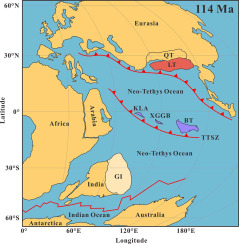
The tectonic evolution of central Tibet was shaped by multiple collisions, notably the Cretaceous collision between the Lhasa and Qiangtang terranes and the subsequent India–Asia collision. Yet, uncertainties in the Early Cretaceous paleogeography of the Lhasa terrane still obscure their timing and mechanisms. Here we present new paleomagnetic data derived from Early Cretaceous sedimentary and volcanic sequences in the northern Lhasa terrane. Field tests, rock magnetic experiments, and petrographic analyses demonstrate that the characteristic remanent magnetizations are primary. Sedimentary rocks show shallower mean directions than volcanic rocks, but Elongation–Inclination analysis effectively corrects this bias, producing consistent paleomagnetic estimates. The combined dataset defines a paleomagnetic pole at 68.6°N, 348.7°E (A95 = 1.4°), indicating a paleolatitude of 25.5° ± 1.4°N for the Bangoin region during the interval of 114–113 Ma. Comparison with the Asian apparent polar wander path suggests 560 ± 200 km of intracontinental shortening since the late Early Cretaceous. Integrated with published paleomagnetic data and geological evidence, these findings indicate that the central and eastern Lhasa terrane had already collided with the Qiangtang terrane at approximately 30°N by ~114 Ma, with subsequent westward propagation of the collision. Moreover, during the late Early Cretaceous, the southern margin of Asia was situated at a paleolatitude exceeding 20°N, in contrast to the coeval low-latitude setting (≤10°N) of the Trans-Tethyan Subduction Zone. This significant paleolatitudinal disparity supports an intra-oceanic equatorial arc–continent collision at ~55 Ma and provides new constraints on the timing and geodynamic mechanisms of the India–Asia collision.
Article link: https://doi.org/10.1016/j.epsl.2026.119859


 Home
Home 
 Address
 E-Mail
 Telephone