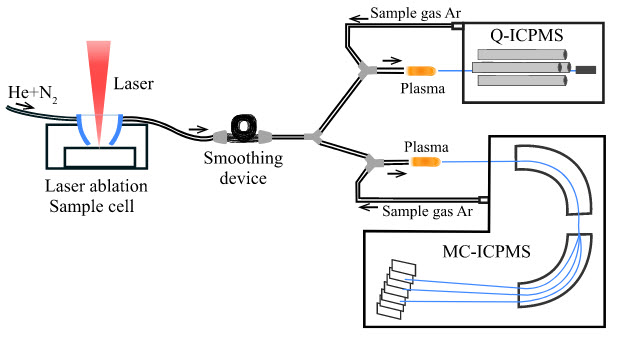
Spatial resolution has long limited the coupled in situ determination of zircon U–Pb ages and Hf isotopic compositions, particularly in grains with thin growth rims and complex core–rim zoning. We present a laser ablation split stream (LASS) depth profiling approach that enables simultaneous, spatially matched U–Pb–Hf analyses along a single continuous ablation trajectory. During one uninterrupted laser ablation sequence, the aerosol is split and introduced concurrently into a Q-ICP-MS and an MC-ICP-MS, allowing direct pairing of U–Pb ages and Hf isotopic ratios from the same ablation volume and eliminating spatial mismatch. Multiple zircon reference materials yield U–Pb ages, trace element concentrations, and Hf isotopic ratios consistent with published values, verifying the accuracy and reliability of this approach. Uncertainty assessment shows that with a signal integration time of at least 5 s, precisions of ≤6% for U–Pb ages and ≤0.000060 for 176Hf/177Hf ratios are achieved, corresponding to a vertical spatial resolution better than 3 μm. Application of this approach to natural zircon grains recording complex crust–mantle interactions produces age spectra comparable to those obtained by conventional depth profiling techniques and delivers a high proportion of valid Hf isotopic data (93%). This LASS depth profiling strategy successfully characterizes rim growth domains as thin as 1.8 μm in zircon grains, thereby enhancing vertical spatial resolution in coupled zircon U–Pb–Hf analyses without sacrificing analytical precision. The method provides a robust tool for high-resolution age–isotope investigations of complex geological processes recorded in zircon.
Article link: https://doi.org/10.1021/acs.analchem.6c01357


 Home
Home 
 Address
 E-Mail
 Telephone